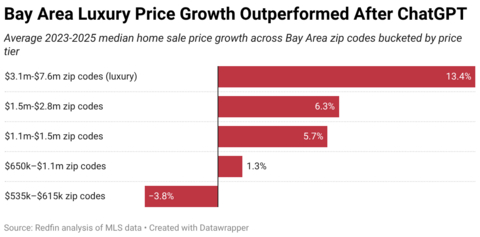
Zip codes in the San Francisco Bay Area known for luxury homes saw a 13.4% average jump in home prices in the two years following the launch of ChatGPT, according to a new report from Redfin. That’s a significantly larger jump than any other price segment in the Bay Area and more than double the 6.3% average increase in the segment immediately below luxury. The most affordable Bay Area zip codes saw home prices fall.
This marks a divergence from the two years leading up to the launch of ChatGPT, when home-price growth was comparable across the Bay Area market. Growth during this 2020-2022 period was close to 20% across the five price segments Redfin analyzed, largely due to record-low mortgage rates and the pandemic homebuying frenzy.
ChatGPT is run by OpenAI, which helped kick off the AI frenzy with its launch in 2022. In March, OpenAI closed a record funding round of $122 billion at a post money valuation of $852 billion.
“Luxury homeowners in Silicon Valley saw their housing wealth jump during the pandemic, and now it’s jumping again thanks to the advent of artificial intelligence and the high-paying jobs that come with it,” said Redfin Senior Economist Yingqi Xu. “Meanwhile, some owners of lower-end properties have missed out on the AI boom, with home prices in the most affordable Bay Area zip codes declining over the past two years. It’s another sign of the K-shaped economy taking shape in the Bay Area, with AI lifting the fortunes of some households and neighborhoods much more than others.”
Redfin’s report uses MLS data to compare growth in median home sale prices across price segments during the following periods: 2020-2022 and 2023-2025. When the report refers to the launch of ChatGPT, it is specifically referring to the launch of GPT-3.5—OpenAI’s language model that debuted in November 2022 and helped turn AI from a niche tool into something millions of everyday people use.
“The Bay Area housing market has picked up tremendously,” said local Redfin Premier real estate agent Ali Mafi. “There has been an influx of AI companies opening up shop, and they’re giving employees giant compensation packages. Some people are getting $1 million bonuses. Homes are getting dozens of offers, which is driving up prices and causing many to sell for hundreds of thousands of dollars over the list price. It’s reminiscent of 2020.”
Redfin reported last month that the median home sale price in the San Francisco metro area jumped 14.4% year over year in March to a record $1.7 million—the largest increase in eight years and the biggest gain among the 50 most populous U.S. metro areas. Another Redfin analysis found that San Francisco’s luxury housing market is significantly outperforming the overall U.S. luxury market.
Housing Markets Not Tied to Tech Have Seen Smaller Luxury Price Gains
In other large, expensive coastal housing markets, luxury home prices did not experience outsized growth after the launch of ChatGPT. This shines a light on how unique the correlation between AI wealth and the luxury housing boom is in the Bay Area.
Many have reported that the housing market in the Bay Area has been heating up, and have loosely attributed that to the AI boom. The analysis in this report, while not causal, goes a step further. It connects the concentration of AI wealth in the Bay Area to price gains at the high end of the housing market and significant price underperformance in the low end of the market—a dynamic that is not playing out in other major metro areas. The fact that this trend is absent in areas with less AI wealth suggests that the AI boom is what is fueling divergence in the Bay Area.
The trend in New York, for example, is the reverse of that in the Bay Area; luxury zip codes saw the slowest growth in the two years after the launch of ChatGPT. In Los Angeles, luxury zip codes outperformed slightly, but not meaningfully. Seattle’s story is similar: Luxury home prices grew at roughly the same pace as two other price tiers from 2023-2025.