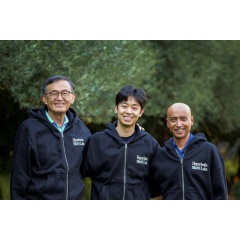
[Photo above: Lip Bu Tan (Intel CEO and Founder of Walden Catalyst), Jasper Zhang (Founder and CEO of Hyperbolic) & Shankar Chandran (Partner at Walden Catalyst)]
The funding will advance Forge, Hyperbolic’s unified control plane, expand its multi-cloud orchestration solutions and value-added services, and develop the first Global Compute Grid.
“The demand for AI compute will continue to grow, but adding more hardware is only part of the answer. The value of that investment depends on how effectively the capacity is put to work and made available to the teams that need it. We believe Jasper and his team are addressing a fundamental challenge in the AI stack, and we’re excited to support them as they build that platform,” said Lip-Bu Tan, Founding Managing Partner at Walden Catalyst and CEO of Intel.
Today’s GPU cloud ecosystem spans more than 300 providers with different hardware, networking, software, and operational standards. AI companies navigate complex procurement, rigid contracts, and engineering overhead, often paying for capacity that sits idle between workloads. GPU providers face a related challenge: turning investments in hardware, power, and data centers into productive capacity and consistent revenue.
This fragmentation makes it harder for buyers to scale and control costs, while idle GPUs reduce providers’ returns on invested capital. Connecting available capacity with the workloads that need it requires both better orchestration and a more efficient market.
Hyperbolic’s approach draws on founder and CEO Jasper Zhang’s expertise in mathematics and quantitative research. A multiple gold medalist in mathematics competitions, Zhang completed his mathematics Ph.D. at UC Berkeley in just two years. During his research at Berkeley AI Research, he experienced firsthand how limited GPU access constrained AI experimentation. He later worked as a quantitative researcher focused on market making at Citadel Securities, developing expertise in financial markets, pricing, and liquidity. Those experiences shaped his conviction that expanding access to AI requires making compute easier to use and easier to trade.
The broader team brings experience from Google Cloud, Lambda, Lightning AI, VMware, Supermicro, Citadel, and Point72, combining cloud engineering with financial markets expertise.
“AI Compute is deeply challenged by supply and demand mismatch, making it incredibly difficult to harness for the AI developer,” said Shankar Chandran, Partner at Walden Catalyst. “Moreover, the myriad of options on compute, interconnects, storage, memory, as well as heterogeneity in the software stack compounds the challenge of accessing available capacity. Hyperbolic’s innovative AI Stack has solved this massive complexity and has aggregated AI compute capacity across compute providers, providing AI developers with simple, transparent, and reliable access to AI compute.”