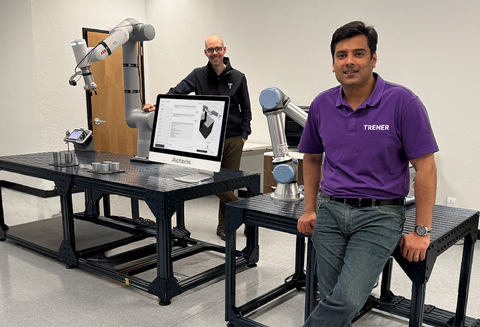
SAN FRANCISCO & TRONDHEIM, NORWAY — Trener Robotics (formerly T-Robotics), developer of an AI robot skills platform for manufacturing, has secured a $32 million Series A round co-led by Engine Ventures and IAG Capital Partners, with participation from strategic investors Cadence and Geodesic Capital, through Nikon’s NFocus Fund. Following closely on its seed round, Trener Robotics’ total funding to date is over $38 million. The new capital will be used to accelerate Trener’s T-Labs R&D, new skill training, global talent acquisition, and market and partner expansion.
[Photo above: Trener Robotics with founders Asad Tirmizi (front) and Lars Tingelstad]
Trener Robotics’ Acteris is a robot agnostic skills platform that instead of rigid coding lets operators describe tasks to automate in their own words, turning conversational input into executable automation. By using physical AI to master vision, language, and movement, the platform adapts to changing parts and unstructured production environments in real-time.
Trained on visual, haptic, language, and action data, Acteris enables industrial robots to self-learn and thrive as workers in complex production environments. Manufacturers using the platform gain:
- An agentic interface enabling robot programming through natural conversation, intuitive task sequences, and high-fidelity simulation—empowering end users and system integrators of any skill level to build safe, high-performance applications
- Part identification and handling with vision, even under adverse conditions
- Optimized robot motions that react to changes with unprecedented robustness
- Intelligent collision avoidance and safety features that mimic common sense
- Real-time production dashboards for performance monitoring
“For decades, industrial robotics has been limited by dynamic complexity, confining millions of robotic arms to repetitive, single-purpose tasks in highly controlled environments,” said Dr. Asad Tirmizi, Co-Founder and CEO of Trener Robotics. “We’re fundamentally changing this – transforming robots into intelligent, adaptable teammates by replacing procedural programming with a control system that supports a growing library of production-ready skills. Our go-to-market strategy empowers systems integrators and OEMs with a robot AI skills platform for deploying and controlling robots across diverse industrial environments.”
Unlike brittle, narrowly scripted systems or research-first generalist platforms, Acteris is a practical, shop-floor-proven solution that runs on the equipment manufacturers already own. Continuous improvement is driven by real production feedback.
In 2025, Trener Robotics demonstrated significant momentum, collaborating with more than 15 solutions and integration partners across Europe and the U.S., and integrating leading robot brands like ABB, Universal Robots and FANUC into Acteris.
“When we co-led Trener Robotics’ seed round, we saw a team with a clear vision to solve one of automation’s biggest bottlenecks,” said Reed Sturtevant, General Partner at Engine Ventures. “Their execution and ability to rapidly scale has been remarkable. This traction positions Acteris as the intelligence layer for physical automation and reinforces their ability to scale through partner-led distribution.”
The market for flexible, adaptable automation is advancing at 14.3% CAGR, driven by persistent labor shortages, demand for high-mix production, and rising operational costs that prompt manufacturers to seek solutions with a rapid return on investment. “Industrial automation is at an inflection point, with Trener Robotics well-positioned as a platform accessible to manufacturers of all sizes, creating a repeatable path for expanding capabilities beyond CNC machine tending. This is precisely what small and mid-sized enterprises globally need to compete as AI redefines manufacturing,” said Dennis Sacha, Partner at IAG Capital Partners.
Trener Robotics was co-founded in 2024 by CEO Dr. Asad Tirmizi and CTO Dr. Lars Tingelstad, who collectively have over two decades of experience in robotics and automation. Tirmizi previously worked at Vicarious, a robotics company acquired by Google, and contributed to the robotics and haptics program at ByteDance Inc., following a tenure at a European manufacturing research institute. Tingelstad served as an Associate Professor of Robotic Production at NTNU. Both have made significant contributions to robot software and control frameworks.